
As a front-end developer working with React, managing form state efficiently is crucial for creating responsive and user-friendly applications. Two popular libraries for handling form state in React are React Hook Form and Redux Form. In this article, we’ll compare these tools to help you choose the right one for your next project.
Introduction
Before diving into the comparison, let’s briefly introduce both libraries:
- React Hook Form: A lightweight library that leverages React Hooks to manage form state and validation. It aims to provide a simple, performant, and flexible solution for form handling.
- Redux Form: A more established library that integrates with Redux to manage form state as part of your application’s global state. It offers a comprehensive solution for complex form scenarios.
Feature Comparison
Let’s compare these libraries across several key aspects:
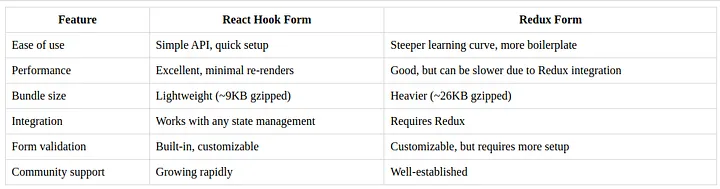
Use Cases:
While both libraries can handle a wide range of form scenarios, they each have strengths that make them more suitable for certain use cases:
When to choose React Hook Form:
- Small to medium-sized applications
- Projects prioritizing performance and bundle size
- Forms with simple to moderately complex validation logic
- When you prefer a minimal setup and API
When to choose Redux Form:
- Large, complex applications already using Redux
- Forms that need to interact with global application state
- Scenarios requiring extensive custom validation and normalization
- When you need to track form state changes over time (time travel debugging)
Code Examples
Let’s look at basic form handling with both libraries:
React Hook Form
import React from 'react';
import { useForm } from 'react-hook-form';

function SimpleForm() {
  const { register, handleSubmit, errors } = useForm();

  const onSubmit = (data) => {
    console.log(data);
  };

  return (
    <form onSubmit={handleSubmit(onSubmit)}>
      <input
        name="email"
        ref={register({
          required: 'Email is required',
          pattern: {
            value: /^\S+@\S+$/i,
            message: 'Invalid email format'
          }
        })}
      />
      {errors.email && <span>{errors.email.message}</span>}

      <input
        name="password"
        type="password"
        ref={register({ required: 'Password is required' })}
      />
      {errors.password && <span>{errors.password.message}</span>}

      <button type="submit">Submit</button>
    </form>
  );
}
Redux Form
import React from 'react';
import { Field, reduxForm } from 'redux-form';

const validate = values => {
  const errors = {};
  if (!values.email) {
    errors.email = 'Email is required';
  } else if (!/^\S+@\S+$/i.test(values.email)) {
    errors.email = 'Invalid email format';
  }
  if (!values.password) {
    errors.password = 'Password is required';
  }
  return errors;
};

const renderField = ({ input, label, type, meta: { touched, error } }) => (
  <div>
    <label>{label}</label>
    <div>
      <input {...input} type={type} />
      {touched && error && <span>{error}</span>}
    </div>
  </div>
);

const SimpleForm = props => {
  const { handleSubmit } = props;
  return (
    <form onSubmit={handleSubmit}>
      <Field name="email" type="email" component={renderField} label="Email" />
      <Field name="password" type="password" component={renderField} label="Password" />
      <button type="submit">Submit</button>
    </form>
  );
};

export default reduxForm({
  form: 'simple',
  validate
})(SimpleForm);
Graphical Representations
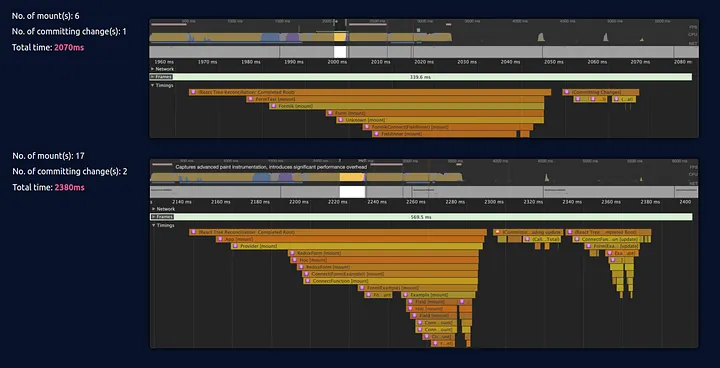
To better understand the differences in data flow and state management between these libraries, let’s look at some diagrams:
Conclusion
Both React Hook Form and Redux Form are powerful tools for managing form state in React applications. Here’s a summary to help you choose:
React Hook Form
- Pros: Lightweight, performant, easy to use, minimal setup
- Cons: Less suitable for complex, globally connected forms
Redux Form
- Pros: Powerful, great for complex forms, integrates well with Redux
- Cons: Heavier, steeper learning curve, requires Redux
Choose React Hook Form if you want a lightweight, performant solution for most form scenarios, especially in smaller to medium-sized applications. Opt for Redux Form if you’re building a large, complex application with Redux and need advanced form state management capabilities.
Remember, the best choice depends on your specific project requirements, team expertise, and application architecture. Consider these factors carefully when making your decision.
Happy coding!